The Estonian Transport Administration (TRAM) is a government agency responsible for managing traffic on land, in the air, and on water. They ensure infrastructure maintenance and general safety. Their primary tasks include the construction and maintenance of state roads, management of the traffic register (vehicles and licenses), and supervision across all transport modes. Their goal is to provide a safe, convenient, and smart mobility environment for people and businesses.
Mapping Application for the Estonian Transport Administration
A unified, interactive GIS mapping solution built on ArcGIS Enterprise, designed to visualize and analyze Road Maintenance Plan (THK) objects. The application replaces manual map generation with a dynamic, group-based visualization tool, enabling smarter infrastructure planning and error detection.
About the Client
| Client | Transpordiamet (TRAM) |
| Link to the project | see here |
| Start of the project | September 2025 |
| End of the project | December 2025 |
Client brief
The Challenge: Lack of Unified GIS Visualization for Maintenance Planning
The Estonian Transport Administration (TRAM) lacked a unified and modern geospatial view for visualizing Road Maintenance Plan (THK) objects by groups and for planning works effectively.
Core Problem:
Fragmented Data and Manual Visualization Processes. Before the solution, TRAM did not have a universal map application that aggregated all THK module data.
- Disparate Systems: Existing applications (Maa-amet X-GIS 2, Google Maps, TEET) were created at different times with separate databases, making them difficult to reconcile.
- No Native Map View: The THK module itself lacked a map application entirely. There was no systematized, grouped overview of road repair, construction, or planning works, their locations, and related data.
- Operational Inefficiency: Existing tools only allowed viewing single objects, not groups based on criteria. Users could not easily move from a list in the THK information system to a map view.
- High Risk of Error: The lack of visual oversight increased the risk of human errors in list compilation, such as overlapping kilometers or conflicting road sections.
- Resource Drain: Staff (communication department, measure managers) had to manually order map extracts from ArcGIS specialists based on object lists. This process was time-consuming, rigid, and hindered optimal planning decisions.
The Solution: Interactive ArcGIS Enterprise Integration
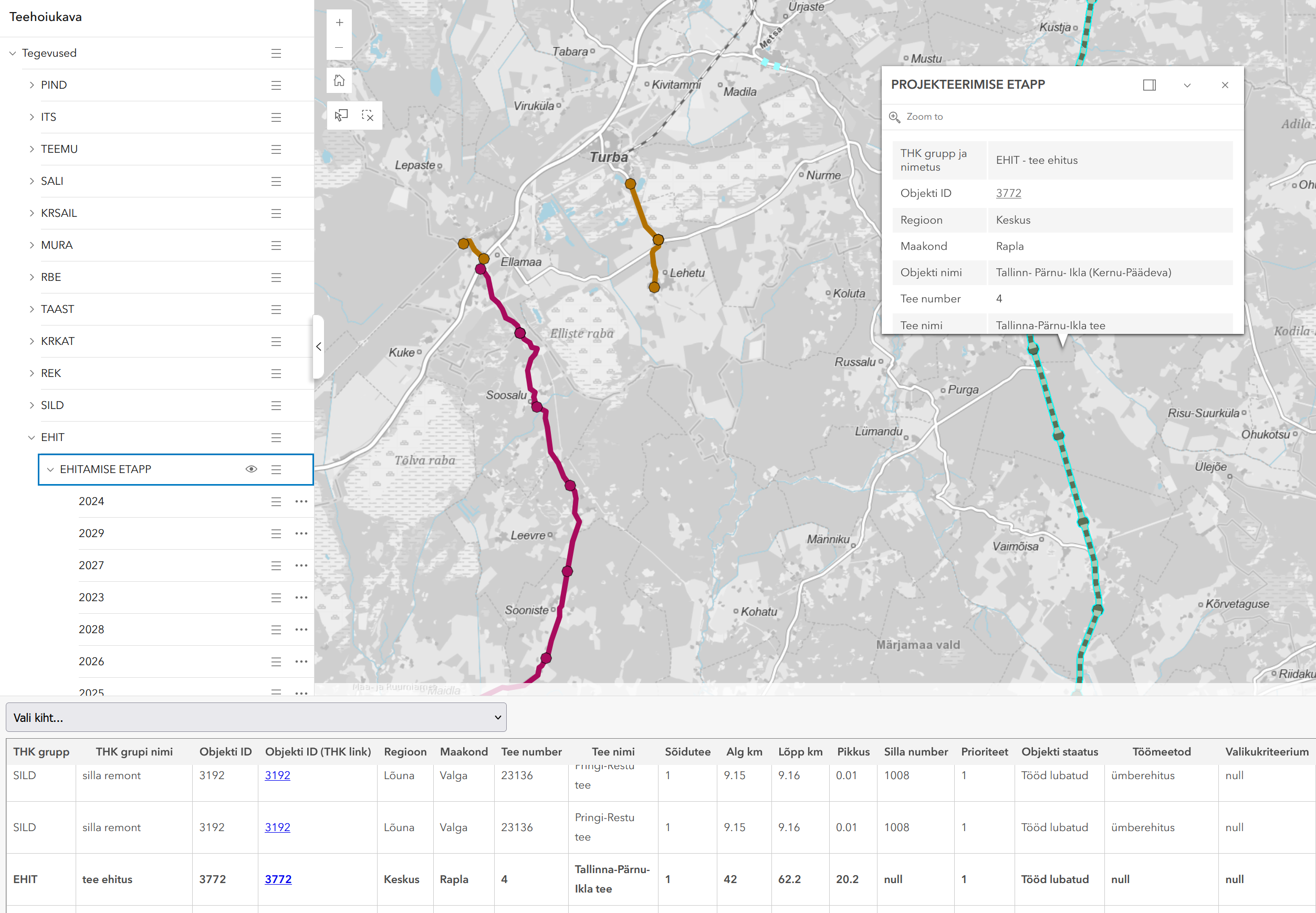
Wenture developed the THK Module Map Application, a centralized GIS solution built on ArcGIS Enterprise. It allows TRAM to visualize and analyze THK objects based on groups and various criteria, replacing the manual “request-and-wait” workflow.
Key Technical Components:
- Hosted Application Architecture: A solution where the THK module provides source data (objects, groups, activities) via backend API endpoints that output data in ArcGIS-compatible formats (GeoJSON, CSV).
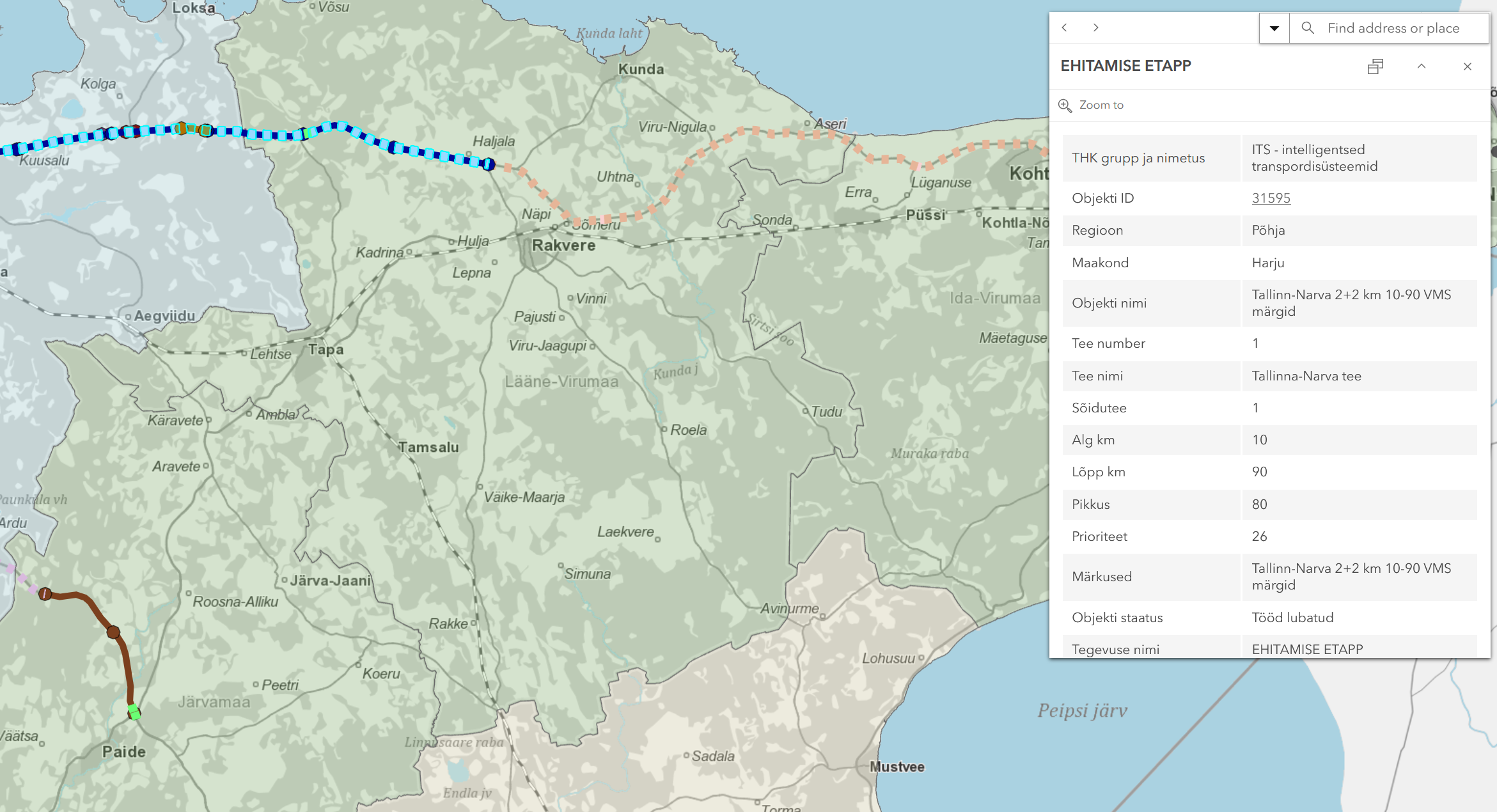
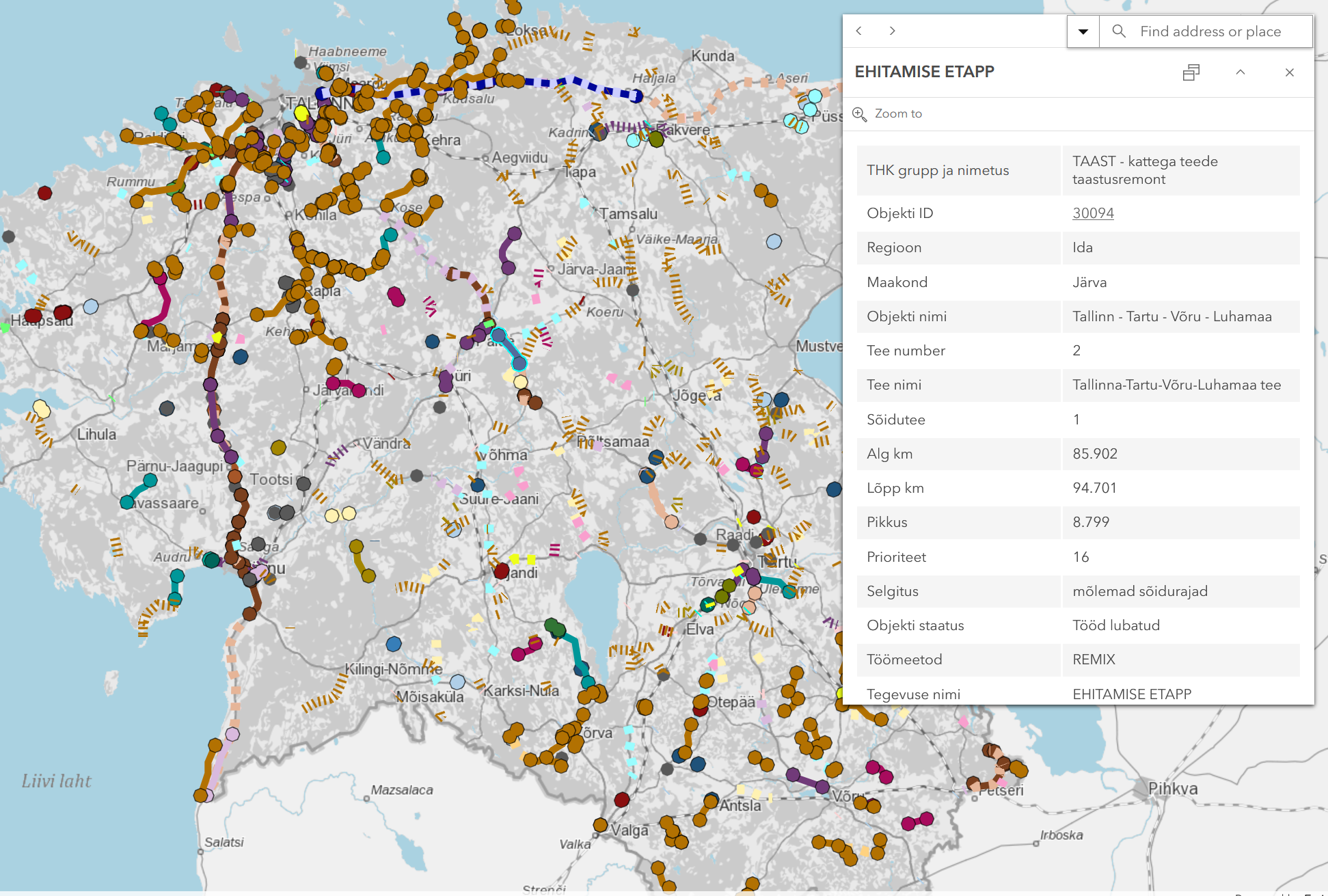
- Group-Based Visualization & Filtering: Enables the simultaneous display of entire object groups on the map based on criteria such as measure/THK group, year range, and activity status.
- Token-Based Large Data Handling: Implemented a UUID token system to handle large datasets. When a user selects many objects in the frontend, the backend generates a unique token to store the selection, bypassing URL character limits (1800+ chars) while allowing massive data rendering.
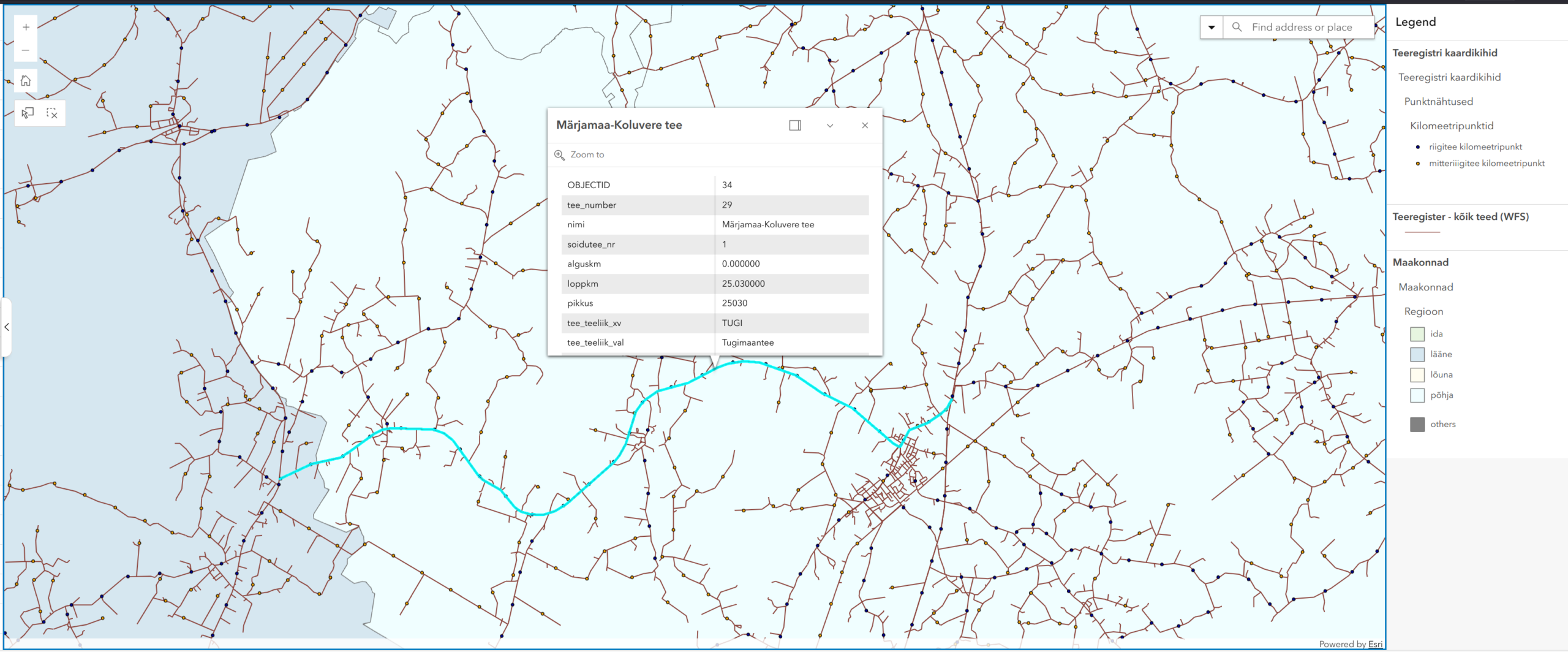
- Interactive Metadata & Search: Clicking an object opens a popup with details (cost, measure, execution year, link to THK module). An integrated search engine allows users to find locations by road number or region via the Road Register (Teeregister) WFS layer.
- Data Synchronization: Created API endpoints for exporting THK objects and activities. While currently using manual intermediate tables (views/HFL), the architecture is designed for future automation where map data updates via cron jobs or triggers.
Tech Stack & Integrations:
- Platform: ArcGIS Server/Portal (Central solution), ArcGIS Maps SDK for Javascript API.
- Backend: Java Spring Framework (for token solutions and API endpoints).
- Database: PostgreSQL.
- Frontend: AngularJS (Legacy THK system integration).
- Integrations: Connected to the Teeregister (Road Register) REST service for geometry and the THK Module for core data.
Results & Impact: From Manual Lists to Strategic Mapping
The new GIS application has fundamentally changed how TRAM plans roadworks. By enabling self-service visualization, the organization has moved from static lists to dynamic, spatial planning.
Key Results:
- Time & Resource Savings: Eliminated the need to order manual map extracts from ArcGIS specialists, freeing up resources for the THK manager, measure managers, and the communication department.
- Error Reduction: The group-based map view helps visually identify overlapping objects or groups, preventing human errors (like coordinate overlaps) that previously required fixing approved lists.
- Optimized Planning: Enables measure managers to identify conflicting activities or opportunities for synergy (e.g., LOK works falling onto a reconstruction object) in the same region, leading to more economically efficient decisions.
- Strategic Alignment: Supports the strategic goal of consolidating all map applications onto the ArcGIS Enterprise platform, reducing maintenance costs and dependency on disparate legacy systems.
- Operational Independence: Management can now validate lists and analyze data visually without relying on third-party interventions.
Future Plans
The solution lays the groundwork for a public-facing web map to visualize planned and active construction objects. Additionally, it provides a migration path to move TEET system functionalities into the THK ArcGIS application, ensuring continuity as TEET is phased out.