There is a question keeping manufacturing CEOs up at night in 2026: Can we afford to quote this? As the demand for speed increases, CPQ for manufacturers is no longer optional—it is a survival mechanism.
We are currently operating in a fractured economy. In core markets like Germany and France, construction activity is stagnant—shrinking by roughly 4% in residential sectors according to recent industry data. Yet, emerging markets in Eastern Europe and the Nordics are seeing growth.
In boom years, Capacity wins. You just need enough machines to keep up. In slow years, Efficiency wins.
For manufacturers, the difference between surviving and scaling comes down to one question: How fast can you accurately quote complex products?
In our latest webinar, we unpacked why manual quoting is facing extinction. Here is the full breakdown.
1. The Dead Zone: Why 5 Days is Too Slow
How many quotes did you lose last year not because of price, but because you were simply too slow?
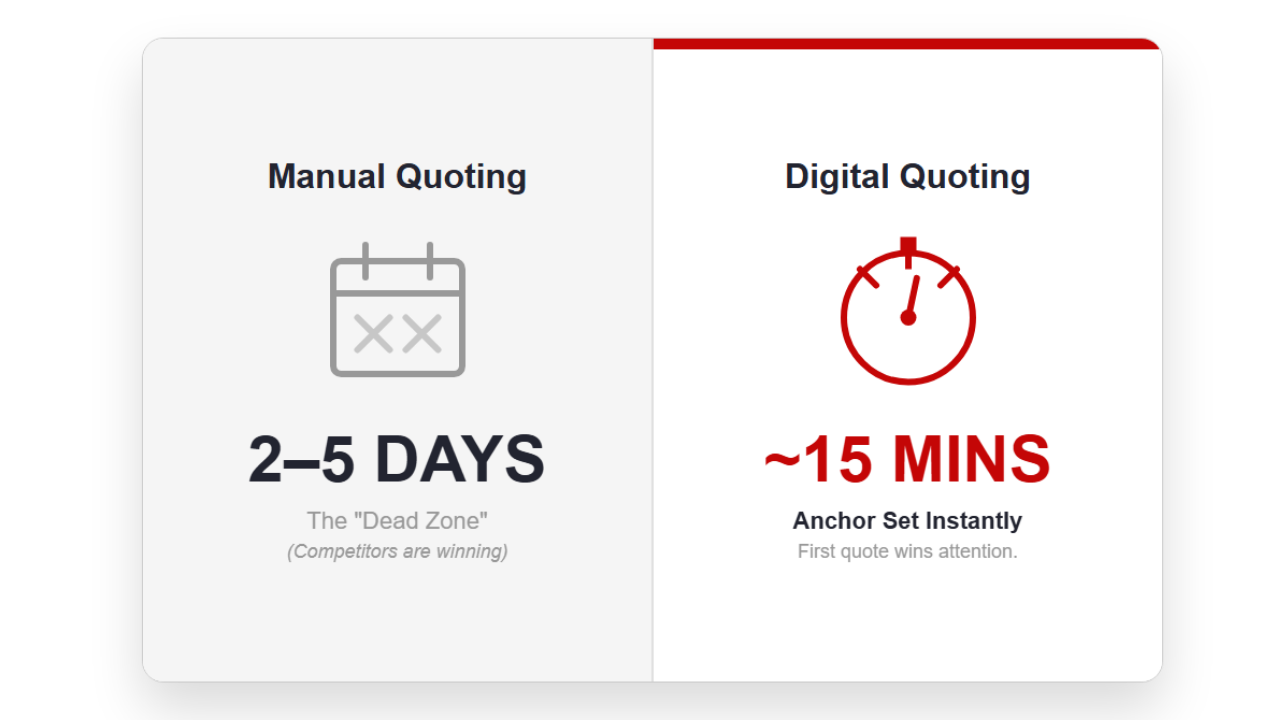
While manual quoting leaves you waiting days, digital quoting sets the price anchor in minutes.
We analyzed the typical Quote Lag Time for manufacturers:
-
Day 1: Request received.
-
Day 4: Sales engineer finally opens the email.
-
Day 7: Quote sent.
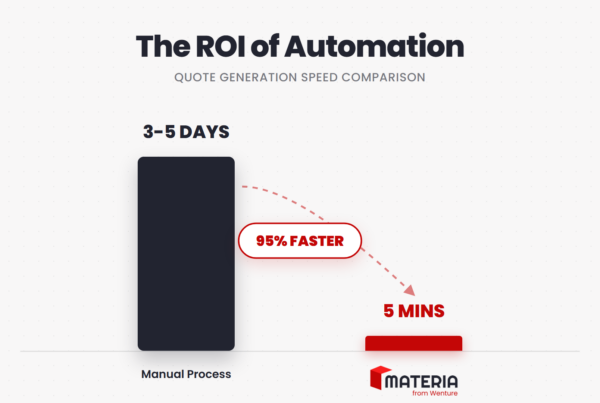
By Day 7, you are in the Dead Zone. Your competitor, who uses automation, sent a price anchor in 15 minutes. They didn’t just win the deal; they framed the entire conversation before you even opened Excel.
Speed = Win Rate. In 2026, 5 days isn’t just slow. It is invisible.
2. The New Buyer: 100% Digital Expectation
The person buying steel beams or custom windows today has changed. They are B2B buyers with B2C expectations. They use Amazon and Netflix at home, and they bring those expectations to work.
They demand Clarity and Control.
-
The Old Way: Contact Sales button → Black hole of silence → Zero clarity.
-
The New Way: Configure Online → Instant Price → Instant Confidence.
Buyers follow the path of least friction. If you force them to talk to a human just to get a price, they will go to the competitor who lets them self-serve.
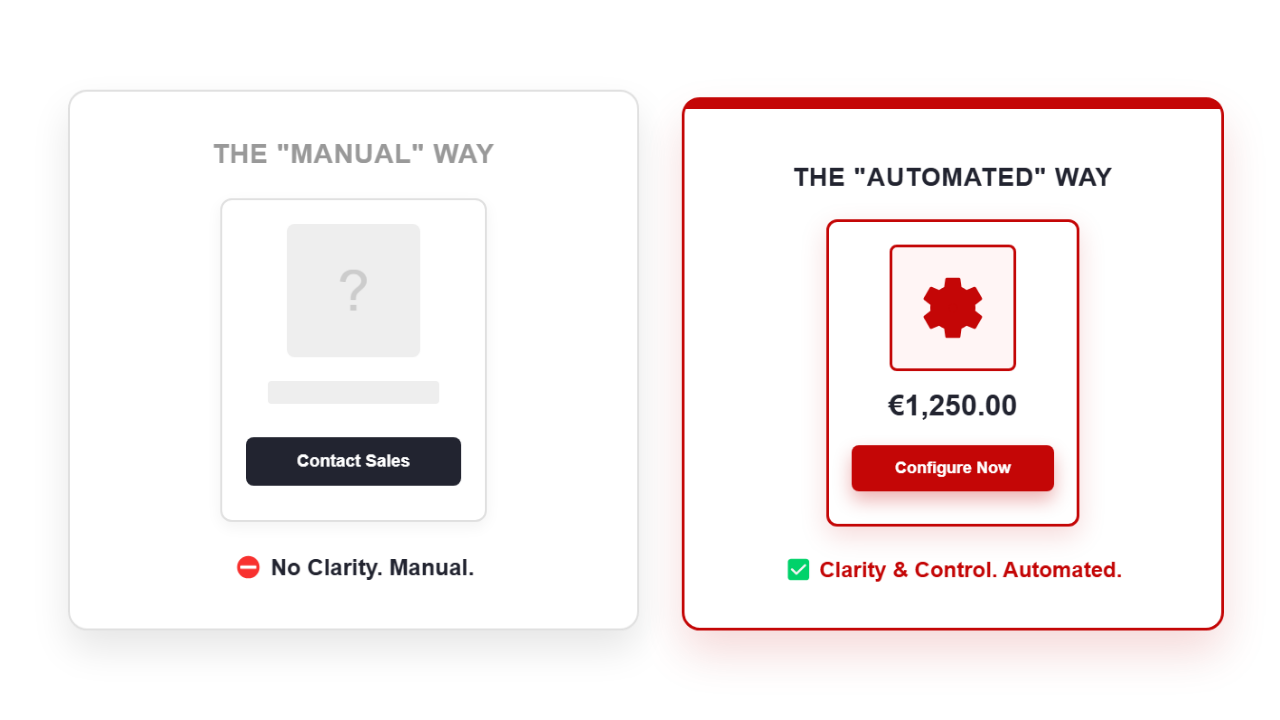
The Buyer Experience Gap. Modern buyers demand instant clarity over “Contact Sales” black holes.
3. Why Manual Quoting is System Failure
Manual quoting isn’t just slow; it creates a System Failure loop inside your company. It relies on:
-
People doing logic (inconsistent).
-
Engineers validating routine cases (bottleneck).
-
Spreadsheets holding business rules (error-prone).
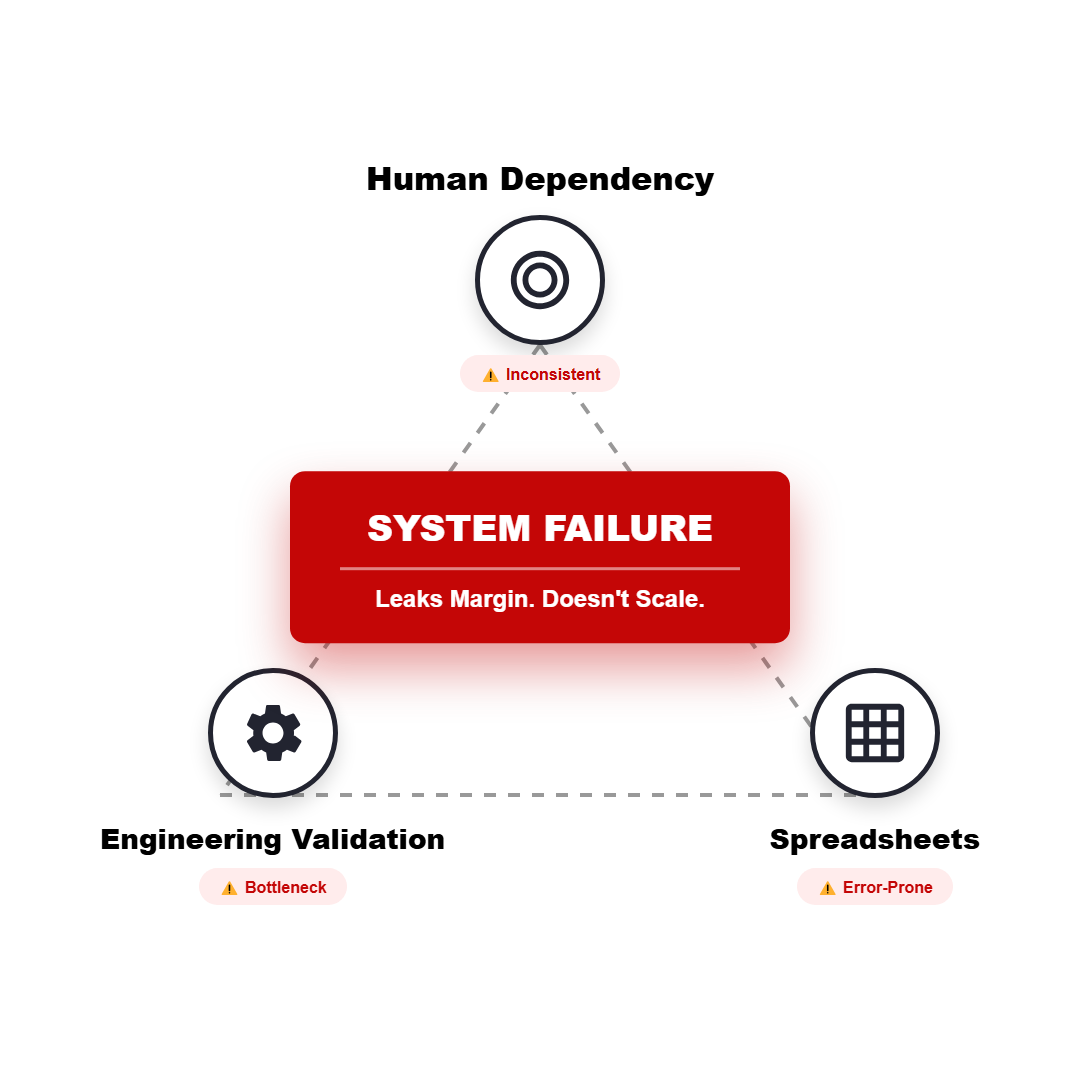
The System Failure loop. Manual processes create a cycle of margin leakage and bottlenecks.
This leads to margin leakage. Every time a sales rep guesses a price or an engineer has to re-draw a standard part, you are losing money. It doesn’t scale because to double your sales, you would have to double your engineering headcount—which is impossible in the current labor market.
4. The Data Stop: Where Standard CPQ system for Manufacturers Fails
Many companies try to fix this with standard CPQ (Configure, Price, Quote) software. To be fair, standard CPQ is great for Sales. It provides rule-based logic and fast PDFs.
But here is where it stops short. We call it the Data Stop.
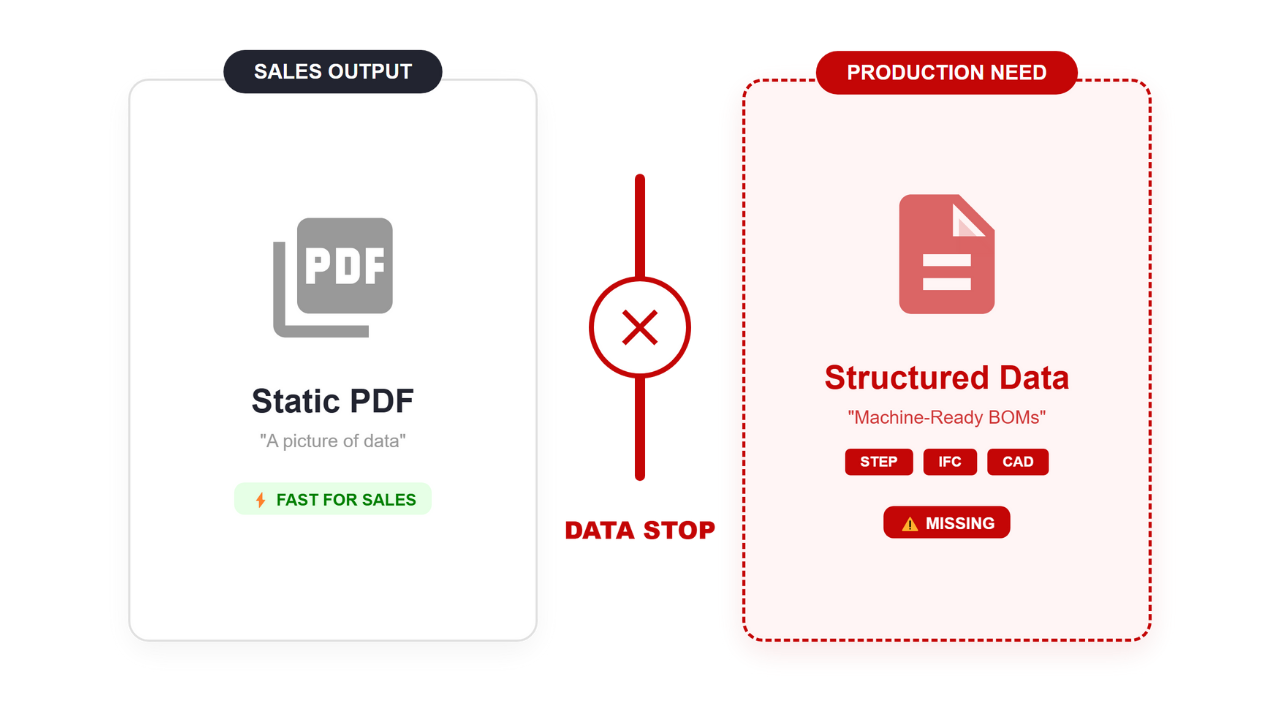
The Data Stop. Standard CPQ system is fast for sales but leaves production with a static PDF instead of usable data.
Most CPQ tools stop at a nice-looking PDF. But the factory cannot build a PDF.
Once the sales rep gets that signature, the data hits a wall. Your engineering team still has to manually translate that PDF into machine-ready BOMs, STEP files, and cut lists. Standard CPQ fixes quoting, but it breaks execution.
5. The Tech Trap: Why Server-Side CAD is Financial Suicide
This is the most critical financial insight for 2026. In the rush to automate, many manufacturers fall into the trap of using Internal Engineering Automation (like DriveWorks or Autodesk Platform Services) for Public Sales.
These tools use Server-Side Architecture, which means they run on Tokens or Concurrent Sessions. Every time a user on your website changes a color, the server spins up a heavy CAD engine.
-
The Cost Trap: You pay for every interaction. If a user spends 20 minutes playing with your configurator, you pay huge compute fees—even if they never buy.
-
The Latency Killer: Every change requires a round-trip to the server, taking 3-10 seconds. In e-commerce, latency kills conversion.
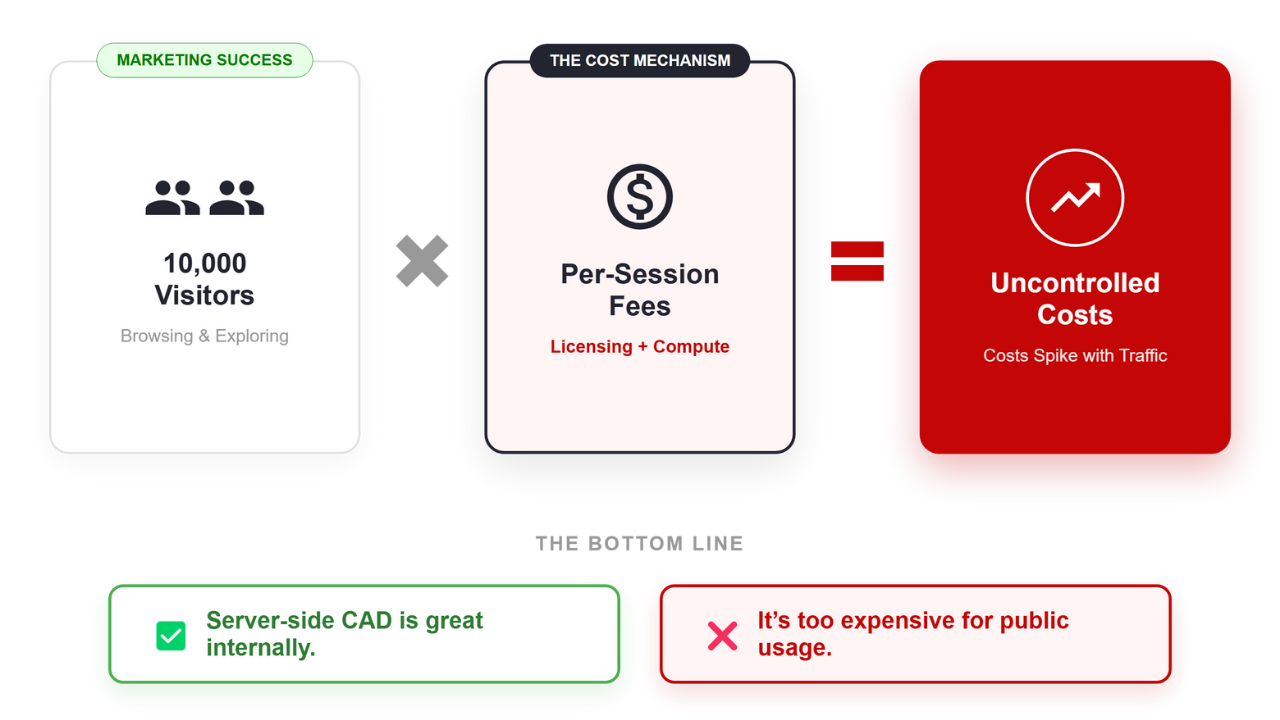
The Pay-to-Browse Trap. Why server-side CAD is great internally but financial suicide for public web traffic.
You are literally penalized for having a successful marketing campaign. This model is economically broken for public web usage.
6. The Solution: CPQ + P (Produce)
The solution is a new framework: CPQ+P. Configure, Price, Quote + Produce.
Manufacturers of complex, engineered products can’t sell online and still rely on slow, manual quoting because traditional e-commerce and CPQ tools break at configuration.
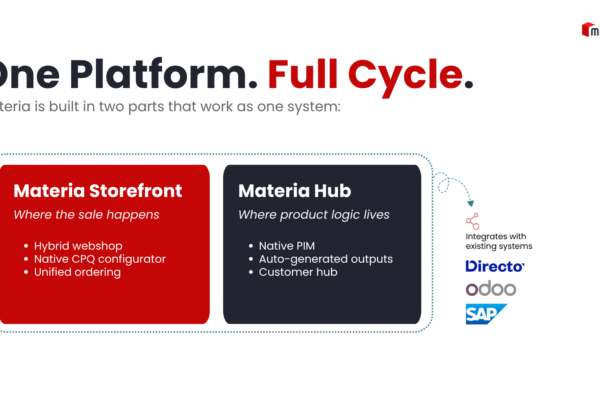
Materia Suite is a B2B2C CPQ and digital-twin platform purpose-built to solve that gap.
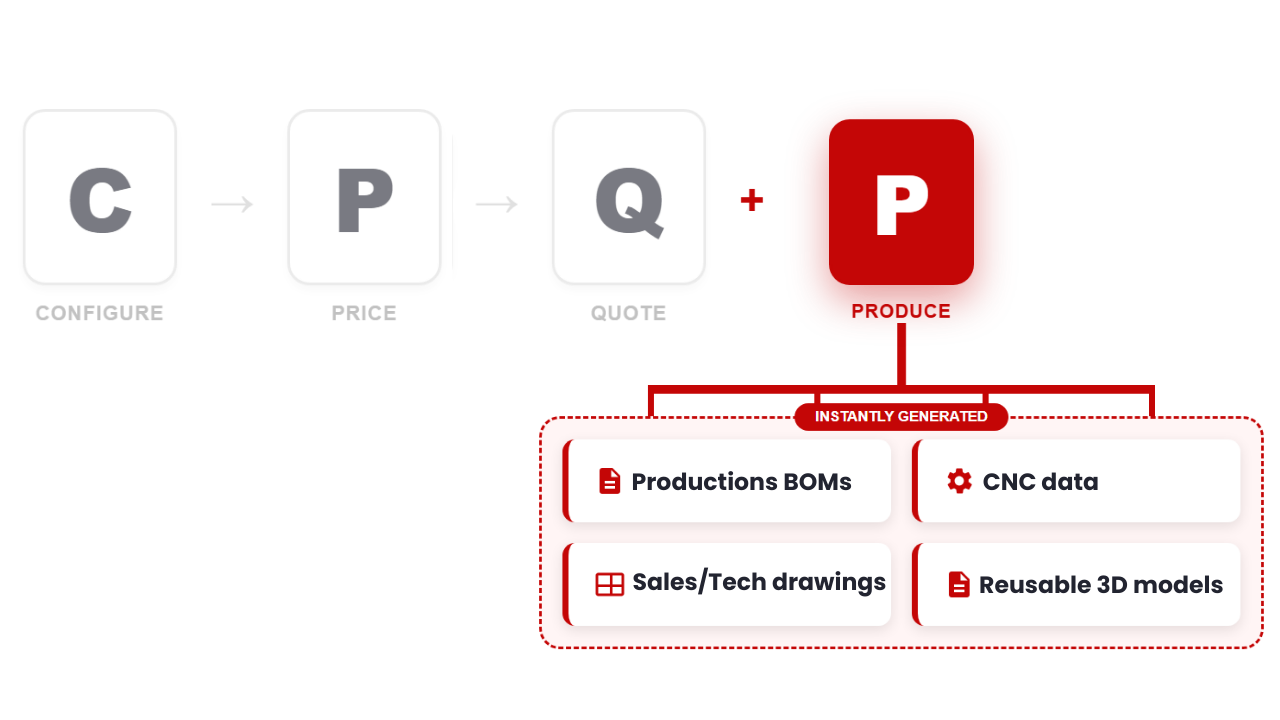
The Produce Engine. Unlike standard CPQ, Materia triggers the instant generation of manufacturing assets.
Unlike traditional CPQ tools that stop at a quote, Materia delivers production-ready output. Every configuration generates accurate pricing, bill of materials, CAD/BIM files (think AutoCAD), and manufacturable 3D models in one flow.
The result is a direct Configure → Price → Quote → Produce pipeline without manual handovers or broken integrations. When a quote is approved, it instantly generates:
-
Production BOMs: Synced directly to ERP.
-
CAD/BIM Files: Auto-generated assets ready for architects.
-
Manufacturable 3D Models: Ready for the factory floor.
-
CNC Data: Machine-ready files for lasers and saws.
7. Case Study: Saku Metall reduced sales cycles from weeks to hours
This isn’t theory. Saku Metall, an Estonian door manufacturer, implemented this exact flow.
The Results:
-
Sales Cycle: Reduced from 2 weeks to 2 hours.
-
Self-Service: 90-95% of orders are now placed independently by partners.
-
Scaling: They scaled sales volume significantly without hiring a single extra engineer.
8. The Final Verdict: Speed vs. Scalability
If your quote cannot go straight to production, you are still guessing.
The winners in 2026 will be the companies that adopt CPQ for manufacturers to decouple their revenue growth from their headcount. They will use CPQ+P system to sell globally while keeping their engineering team focused on R&D, not data entry.
Ready to validate your own engine? If you want to see how the Materia Suite can automate your specific product rules—from complex pricing to instant BOMs—explore the platform below.
P.S. Still using Excel to quote? Let’s look at your workflow together. Book a 30-minute demo and we can show you exactly where the CPQ+P model would fit into your production line.