The European Union is reshaping how products are made, sold, and tracked. At the heart of this shift sits the EU Digital Product Passport (DPP) — a new mandatory digital record tied to every physical product placed on the EU market, designed to drive transparency and sustainability across the entire value chain.
If you manufacture steel, cement, aluminium, textiles, or other construction materials, DPP compliance is no longer a future concern. The regulatory requirements are already in force, and the deadlines are tightening fast. This guide covers what a digital product passport is, what the EU’s DPP framework demands, and how manufacturers can start preparing before the pressure hits.
What Is a Digital Product Passport (DPP)?
A digital product passport is a structured digital record linked to a physical product via a data carrier — typically a QR code, barcode, or digital identifier — that stores verified information about that product’s materials, environmental impact, certifications, and lifecycle data.
The goal is product transparency: any stakeholder in the supply chain — a buyer, architect, contractor, or regulator — can scan the data carrier and immediately access reliable, up-to-date passport data. No email chains. No outdated PDFs. No delays.
DPPs form a cornerstone of the EU’s strategy for a circular economy and product sustainability. Furthermore, they support circular business models by making it easier to track, reuse, and recycle materials — helping manufacturers and buyers alike make informed decisions throughout the lifecycle of a product.
Crucially, a DPP is not a static document. Instead, it functions as a living digital identity for a product — updated as the product and its supply chain evolve over time.
EU Digital Product Passport Requirements: The ESPR and Construction Products Regulation
DPPs sit within two overlapping regulatory frameworks that every EU manufacturer needs to understand.
The Ecodesign for Sustainable Products Regulation (ESPR)
The Ecodesign for Sustainable Products Regulation (ESPR) entered into force in July 2024 and serves as the primary EU framework governing DPP rollout across product groups. It replaces the old Ecodesign Directive and significantly expands its scope — from energy-related products to virtually all categories of goods sold in the EU, including textiles and batteries, consumer electronics, furniture, and more.
Under the ESPR, each product must carry a unique product identifier linked to a passport system that makes product lifecycle data accessible to regulators, buyers, and recyclers. Additionally, the European Commission publishes delegated acts per product category specifying the exact information requirements — what passport data must be included, in what format, and by when.
The EU strategy for sustainable products underpinning the ESPR connects directly to the EU Circular Economy Action Plan, which calls for every product placed on the EU market to become more durable, repairable, and recyclable by 2030.
The Revised Construction Products Regulation (CPR)
For construction materials specifically, the digital product passport requirements come from Regulation (EU) 2024/3110 — the revised Construction Products Regulation. This new regulation entered into force on January 7, 2025, and mandates phased environmental reporting and full DPPs for priority construction products, with compliance deadlines running through 2032.
Importantly, manufacturers based outside the EU who sell products in the EU face the same obligations. DPP compliance ties to market access, not country of origin.
The Regulatory Timeline: What’s Mandatory and When
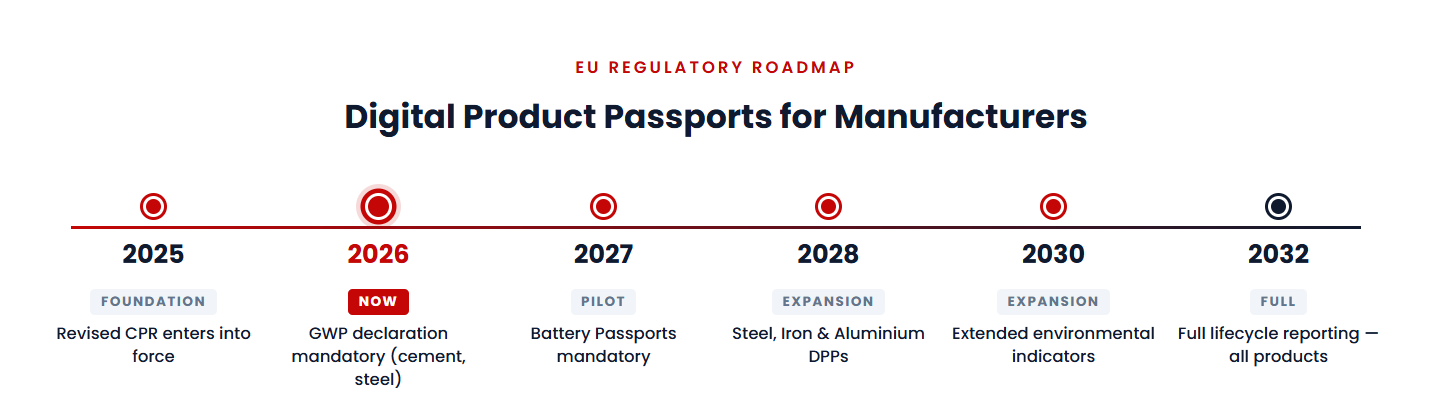
Here is the full EU rollout schedule manufacturers need to plan around.
January 7, 2025 — Legal foundation. The revised Construction Products Regulation enters into force. As a result, the new digital framework for construction products takes effect, including the path to mandatory DPPs.
January 8, 2026 — GWP declarations mandatory now. Manufacturers of priority construction products — including cement and steel — must declare Global Warming Potential (GWP) as part of their Declaration of Performance. This is the first enforceable regulatory requirement under the new regulation. If your products are placed on the EU market, this already applies to you.
February 18, 2027 — Battery Passport mandatory. Under the EU Battery Regulation (EU) 2023/1542, the battery passport becomes mandatory for EV batteries, industrial batteries above 2 kWh, and light transport batteries. Consequently, this battery regulation milestone acts as the EU’s first fully mandatory DPP — the passport system pilot that sets the template for every sector to follow.
2028 — Steel, Iron & Aluminium DPPs. Full digital product passports become mandatory for iron, steel, and aluminium product categories — among the highest-volume construction products in Europe.
January 9, 2030 — Extended environmental indicators. The second compliance phase expands DPP reporting to cover additional environmental indicators: acidification, resource use, water impact, and more. Moreover, this phase covers a significantly wider product scope than the 2026 requirements.
January 9, 2032 — Full lifecycle reporting. Complete product lifecycle environmental data management becomes mandatory for virtually all construction products. This marks the endpoint of a decade-long regulatory shift tied to the EU Circular Economy Action Plan.
Beyond construction, the EU is actively working on delegated acts under the ESPR for textiles, consumer electronics, furniture, and other product groups — meaning DPP requirements will expand well beyond construction materials before 2030.
What Passport Data Does a DPP Need to Contain?
Product Identity and Traceability
Every compliant DPP starts with a clear digital identity for the product. Manufacturers must provide a unique product identifier — the product ID that links the data carrier to the passport system — along with manufacturer details, country of origin, and product model, batch, and serial information. Together, these fields enable end-to-end traceability across the value chain.
Environmental and Lifecycle Data
This is where most manufacturers face the steepest preparation challenge. A digital product passport must include Global Warming Potential (GWP) — mandatory from 2026 — alongside full product lifecycle data covering production, use, and end-of-life stages. Furthermore, environmental impact indicators such as acidification and resource use phase in progressively through 2030–2032.
Supply Chain and Sourcing
Supply chain transparency is built into the DPP framework by design. Manufacturers must therefore document material composition and source information, as well as reliable product data from suppliers verified against EU standards.
Circularity and End-of-Life
To support the circular economy, a compliant DPP must include recycled content percentage, product durability and disassembly potential, reuse and recycling instructions, and circularity indicators. These requirements phase in fully by 2030–2032 under EU regulations.
Access via Data Carrier
Finally, the digital product passport must be accessible via a scannable data carrier — a QR code, barcode, or NFC tag — that links to live, updatable passport data. A static PDF does not meet the DPP requirements.
Supply Chain Transparency and Traceability: The Hidden Challenge
One of the most underestimated aspects of DPP compliance is supply chain transparency. Your digital product passport is only as accurate as the data your suppliers provide. For steel manufacturers, that means obtaining verified emissions data from raw material sources. For textile producers, it means mapping material origins across complex multi-tier supply chains.
Traceability is built into every DPP by regulatory design — regulators and buyers need to verify the product and its supply chain back to source. The European Union is explicit: passport data must come from verified, reliable product data, not estimates.
As a result, early supplier engagement is a prerequisite for DPP compliance — not an optional extra. Manufacturers who begin mapping their supply chain now will be in a fundamentally stronger position by 2027 than those who wait.
The value chain implication is equally significant: your buyers will soon require product information that you can only provide if your suppliers have already delivered it to you.
Preparing for Digital Product Passports: A Practical Roadmap
Audit Your Product Data
Most manufacturers discover that their product information is scattered across ERP systems, spreadsheets, and email threads. However, DPP requirements demand that product lifecycle data is centralised, structured, and linked to a unique product identifier. None of that is achievable without a proper data management foundation.
Calculate Your Environmental Data
GWP declarations are mandatory now for priority construction products. Therefore, if you have not yet calculated your carbon footprint per SKU, that must happen before anything else. Work with an LCA provider aligned with EN 15804 to generate verified product lifecycle data for each product in your catalogue.
Engage Your Supply Chain Early
Start conversations with key suppliers about data management and product transparency. The information requirements under the ESPR and CPR flow upstream — your suppliers need to be ready to share verified data with you well ahead of the EU market deadlines.
Implement a Digital System for Product Information Management
Spreadsheets cannot handle the volume, structure, and update frequency that DPP compliance requires. A product information management (PIM) platform centralises product information across all SKUs, generates data carriers, and ensures passport data stays current. Consequently, it is the single most important infrastructure investment manufacturers can make today.
Meet DPP Requirements Ahead of the Deadline
Companies that implement digital product passports early gain a clear competitive advantage: cleaner data, fewer compliance gaps, and the ability to use product sustainability data as a differentiator in sales and procurement — rather than a last-minute obligation.
How Materia Helps You Implement Digital Product Passports
Materia’s product information management platform is built for manufacturers who need to implement digital product passports without building a compliance team from scratch. Digital Product Passports are native to the platform — not an add-on.
With Materia, you can:
- Generate QR codes and barcodes as data carriers directly from product records, giving any stakeholder instant access to full passport data: materials, certifications, GWP declarations, and more.
- Centralise product information across your entire catalogue in one digital system, so your DPP always reflects accurate, up-to-date data.
- Manage product lifecycle data in one place, making it straightforward to meet expanding DPP requirements as EU regulations evolve through 2028 and 2030.
- Support supply chain transparency by structuring supplier data and making it traceable back to source.
- Combine CPQ and product information management in one platform, so your sales and compliance teams always work from the same product data.
In short, manufacturers who implement Materia now are not simply meeting regulatory requirements — they are building the product data foundation that EU market access, quoting, and DPP compliance will depend on for the next decade.
See how Digital Product Passports work in Materia →
Frequently Asked Questions on DPP Compliance
Who do EU digital product passport requirements apply to? The DPP requirements under the ESPR and CPR apply to any manufacturer or importer placing products in the EU — including those based outside the EU. If your construction products, textiles, batteries, or other goods are sold in the EU, these regulations apply regardless of where you manufacture.
Is a Digital Product Passport the same as an Environmental Product Declaration (EPD)? No — although the two overlap. An EPD reports a product’s environmental impact based on a lifecycle assessment. A DPP, however, is a broader digital record that includes EPD data alongside product identity, traceability, performance declarations, circularity data, and end-of-life information. Your EPD data feeds into your DPP, but the passport system contains considerably more.
What is the ESPR and how does it relate to DPPs? The ESPR is the overarching EU framework governing DPP rollout across industries. Specifically, it mandates digital product passport requirements for product groups via delegated acts published by the European Commission. The CPR sits within this broader ESPR framework and applies specifically to construction products.
What happens if I don’t comply? Non-compliant products face exclusion from the EU market. Beyond legal penalties, the greater commercial risk is losing access to buyers and procurement processes that require verified DPP compliance documentation. Regulators increasingly request passport data as part of tender and procurement processes.
Do I need a separate system to meet DPP requirements? Not necessarily. A DPP requires centralised, structured product data linked to a data carrier — precisely what a product information management platform provides. Therefore, if your product information is already managed in a system like Materia, adding DPP output becomes a natural extension rather than a separate project.
When are digital product passports mandatory for steel manufacturers? GWP declarations for steel are already required from January 2026 under the revised Construction Products Regulation. Full digital product passports for iron, steel, and aluminium are expected around 2028. Under the ESPR, further delegated acts will extend DPP requirements to additional product categories before 2030.
What is the connection between DPPs and the circular economy? DPPs are a direct instrument of the EU Circular Economy Action Plan. By making product lifecycle data — including material composition, recycling instructions, and end-of-life options — accessible to every stakeholder in the value chain, DPPs enable circular business models, better reuse rates, and more efficient recycling. Sustainability and circularity are, in other words, built into the DPP framework by design.
The Bottom Line on EU Digital Product Passport Compliance
Digital product passports are not a distant EU initiative — the regulatory requirements are already in effect. GWP declarations are mandatory today for priority construction products, the battery passport deadline arrives in 2027, and DPP compliance for steel and aluminium follows in 2028. By 2030, almost all product categories will require full product lifecycle environmental data.
Transparency and sustainability are no longer optional for manufacturers selling products in the EU. The question is therefore not whether you will need to implement digital product passports — it is whether your product data, supply chain transparency, and data management infrastructure will be ready when the deadline arrives.
Materia is a CPQ and product information management platform built for manufacturers. Digital Product Passports are a native part of the platform — so DPP compliance does not require a separate tool.